
Ultimate Guide to Competitive Landscape Analysis for SaaS
Back

Alexander Chua
2025-12-11T06:59:44.295Z
Table of contents:
Share this

Competitive Landscape Analysis is essential for SaaS companies to stay ahead in a crowded market. It involves understanding competitors' strategies, customer needs, and market trends to make informed decisions about product development, pricing, and positioning. Here's what you need to know:
- Key Goals: Identify market gaps, emerging trends, and opportunities to differentiate your product.
- Core Metrics: Focus on ARR, MRR, churn rates, CAC, LTV, and NRR to evaluate competitors.
- Customer Insights: Analyze competitors' target segments, pain points, and customer feedback.
- Frameworks: Use tools like SWOT analysis, Porter’s Five Forces, and market positioning maps.
- Tools to Track Competitors: Platforms like Ahrefs, G2, Crunchbase, and Similarweb help gather actionable data.
- Actionable Steps: Regularly update competitor tracking systems, refine messaging, and adjust pricing based on insights.
This process improves decision-making across teams, helping SaaS businesses reduce risks, optimize strategies, and accelerate growth.
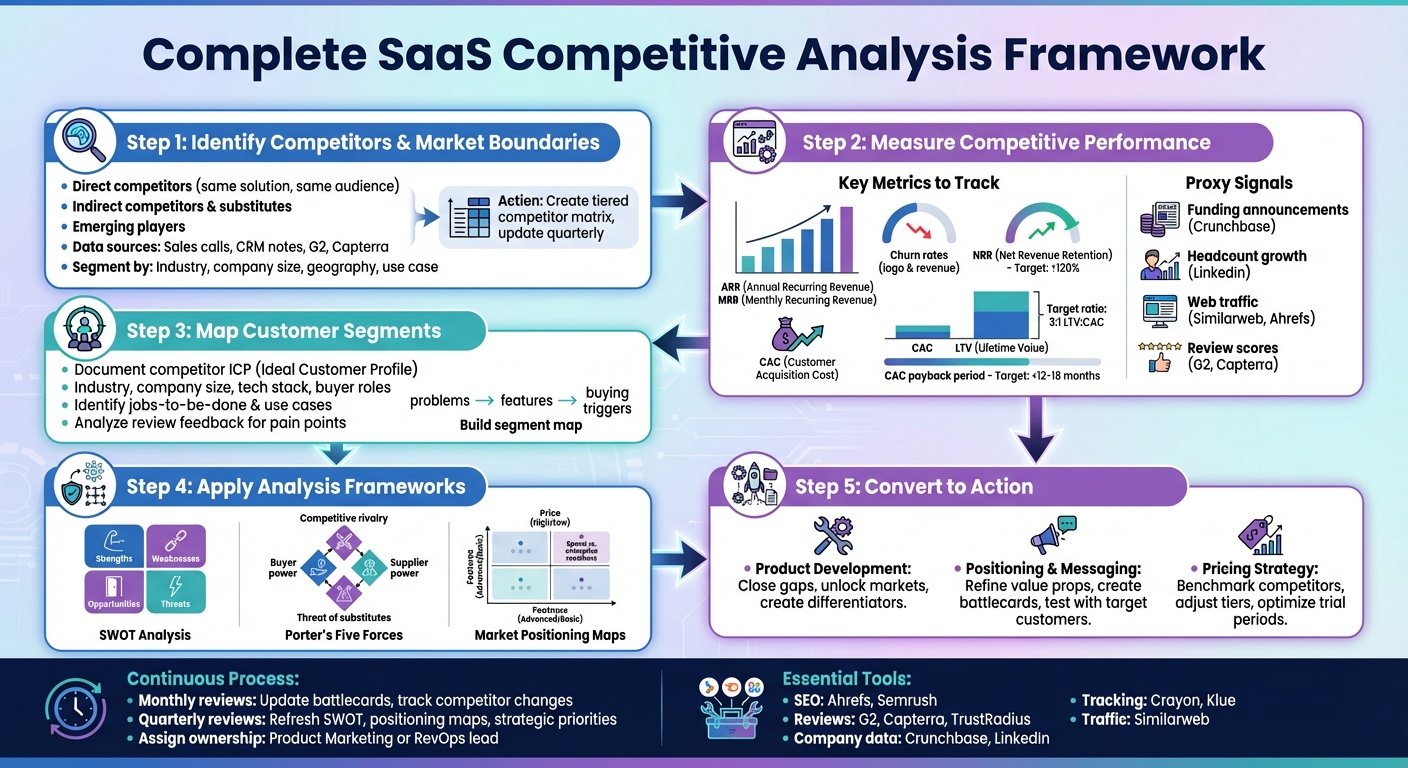
SaaS Competitive Analysis Framework: 5-Step Process for Market Intelligence
Core Elements of SaaS Competitive Analysis
Identifying Competitors and Market Boundaries
SaaS teams often start by pinpointing direct competitors - those offering similar solutions to the same audience. For instance, Asana and Monday.com both cater to project management needs for knowledge workers. However, it’s equally important to monitor indirect competitors, substitutes, and up-and-coming players.
To get a complete picture of your competition, dig into your sales and onboarding data. Ask prospects during discovery calls which tools they’ve used or considered before choosing your product. Check CRM notes and win-loss interviews for insights about alternative solutions or workarounds. Platforms like G2 and Capterra are also great for identifying tools customers compare during their decision-making process. Define your market boundaries by factors like industry, company size, geography, and primary use case. A tiered competitor matrix can help you organize this information, with rows representing key market segments and columns listing direct, indirect, and aspirational competitors. Make it a habit to update this matrix quarterly to account for new players and shifting dynamics. Once you’ve mapped the competitive landscape, the next step is measuring how these competitors perform.
Measuring Competitive Performance
Identifying competitors is just the start; understanding their performance is where the real insights emerge. Focus on key SaaS metrics like ARR (Annual Recurring Revenue), MRR (Monthly Recurring Revenue), churn rates (both logo and revenue churn), Net Revenue Retention (NRR), Customer Acquisition Cost (CAC), Lifetime Value (LTV), and CAC payback period. Benchmarks to aim for include an NRR above 120%, an LTV:CAC ratio of 3:1 or better, and a CAC payback period under 12–18 months.
While exact numbers might not always be available, proxy signals can offer valuable clues. For instance, funding announcements on Crunchbase, headcount growth on LinkedIn, and web traffic trends from tools like Similarweb or Ahrefs can provide insights into ARR and growth rates. Review platforms like G2 and Capterra can highlight customer satisfaction levels and potential churn risks. Additionally, visible ad spend, sales team size, and pricing strategies can help you estimate a competitor’s CAC and go-to-market efficiency. Instead of relying on static spreadsheets, consider visualizing this data on a 2×2 matrix - such as plotting growth rate against efficiency or market share against customer satisfaction - to uncover strategic opportunities. Once you’ve assessed performance, it’s time to dive into the customer segments competitors are targeting.
Mapping Customer Segments and Requirements
Understanding which customer segments your competitors serve is just as important as analyzing their performance. Start by documenting each competitor’s Ideal Customer Profile (ICP), which includes details like industry, company size, tech stack, and buyer roles. Then, map their primary jobs-to-be-done and use cases by studying their website messaging, case studies, and product tours. For example, does a competitor focus on reducing onboarding time, consolidating tools, or boosting pipeline velocity?.
Review platforms can also offer valuable insights. Look for recurring feedback - whether it’s complaints about poor support, clunky user interfaces, or missing integrations - to identify weaknesses you can capitalize on. Use customer interviews, win-loss analyses, and CRM data to understand the challenges different segments face, areas where competitors excel, and where they fall short. Building a segment map that outlines each group’s key problems, must-have features, buying triggers, and commonly used tools can directly inform your product roadmap and positioning.
For U.S.-based B2B SaaS teams experiencing rapid growth, working with specialized marketing and RevOps agencies like PipelineRoad can help turn these insights into action. They can support integrated go-to-market campaigns, account-based marketing strategies, and structured roadmaps that bridge the gap between segment analysis and revenue outcomes.
Mastering the art of B2B SaaS competitor research
Frameworks and Tools for Competitive Analysis
This collection of frameworks and tools not only guides your competitive analysis but also supports key strategic business decisions.
Using Analysis Frameworks
SWOT Analysis helps anchor your strategy in measurable data, such as feature adoption rates, Net Promoter Scores (NPS), and renewal metrics. For instance, when evaluating onboarding, consider features like in-app checklists or time-to-first-value. These insights can be integrated into your SWOT framework to pinpoint strengths, weaknesses, opportunities, and threats, providing clear areas where you can excel.
Porter’s Five Forces offers a broader view of the market structure. Use it to evaluate competitive rivalry by tracking the number of alternatives and monitoring feature updates. Analyze buyer power by reviewing contract terms, switching costs (e.g., data migration challenges), and customer concentration levels. Don’t overlook the threat of substitutes - spreadsheets, generic tools, or manual processes can often replace specialized solutions. For supplier power, assess dependencies on key providers like cloud platforms or payment processors, especially if there are reports of service outages or price hikes. For example, a SaaS analytics platform might notice strong buyer power among small businesses due to numerous low-cost options. This insight could encourage a pivot toward mid-market accounts, where deeper integrations can foster stronger customer loyalty.
Market positioning maps, often visualized as 2×2 matrices, help you understand where you and your competitors stand on key buyer priorities, such as implementation speed versus enterprise readiness or pricing versus automation capabilities. By leveraging data from platforms like G2, web traffic estimations, and pricing comparisons, you can identify crowded areas and untapped opportunities for differentiation. Regularly updating these maps ensures your strategy and messaging stay aligned with market dynamics.
Once you’ve gathered these insights, you can enhance your efforts by using specialized tools to keep track of market shifts in real time.
SaaS Analysis Tools
Competitive intelligence relies on pulling data from diverse tools. Platforms like Ahrefs and Semrush reveal competitor SEO strategies, while review sites such as G2, Capterra, and TrustRadius provide customer feedback, satisfaction scores, and feature comparisons that expose both strengths and recurring pain points. Databases like Crunchbase and LinkedIn offer insights into company size, funding rounds, and headcount growth, which can help you identify fast-growing competitors and evaluate their market reach. Tools like Crayon and Klue track changes in pricing, product updates, and marketing campaigns, enabling you to spot strategic shifts early. Additionally, platforms like Similarweb provide web traffic and engagement data, often with enterprise-level pricing options.
To create a comprehensive workflow, integrate these tools effectively. For example, you could pull keyword data monthly to identify content gaps, monitor review sites for emerging customer themes, and check funding databases quarterly for announcements signaling potential competitive moves.
Combine the outputs from these tools into a structured system to maintain ongoing visibility into your competitive landscape.
Building a Competitor Tracking System
Centralizing insights into a competitor inventory table makes it easier to spot trends and share updates across teams. Include key data points such as company details, target markets, product features, deployment models, and onboarding methods. Use simple flags like Yes/No/Partial for feature parity to help product managers quickly identify areas where your offering leads or lags. For pricing, document list prices (in USD), billing models (monthly vs. annual), packaging tiers, discount structures, trial lengths, freemium options, and any usage-based components. Add fields for positioning elements like taglines, value propositions, target industries, differentiators, and go-to-market strategies (e.g., product-led vs. sales-led). Be sure to include data sources and update timestamps for transparency.
Assign product marketing or RevOps teams to handle monthly updates for incremental changes, such as feature launches or pricing adjustments, and conduct quarterly reviews to refresh SWOT analyses, Five Forces evaluations, and positioning maps. Feed updates from your tool stack directly into the inventory table, and summarize key changes into concise competitive briefs or battlecards for sales and customer-facing teams. Product managers can use this system to align roadmaps with competitive gaps, while marketing teams can refine messaging based on the latest insights.
For U.S.-based B2B SaaS teams, partnering with experts can streamline the process of operationalizing these frameworks and tools. For instance, PipelineRoad offers discovery audits that include competitive landscape reviews, SEO analyses, and go-to-market strategy evaluations. Their recommendations are grounded in structured frameworks and data-driven insights, helping teams accelerate their decision-making process.
sbb-itb-ab67128
Converting Analysis into Business Decisions
Take the competitor metrics and customer insights you've gathered and turn them into actionable strategies. Break your findings into three main areas: product gaps, positioning opportunities, and pricing challenges. Evaluate each area based on its potential impact on ARR (annual recurring revenue) and the resources - time, budget, and risk - needed to address it. For instance, if competitors excel at onboarding while your NPS is high but your time-to-value is 14 days, focus on reducing that time to 5 days within two quarters. Assign clear ownership to these priorities, like having the Chief Product Officer handle product improvements or the Chief Marketing Officer lead positioning efforts. Tie these goals to measurable KPIs, such as win rates against your top three competitors or growth in expansion revenue.
Improving Positioning and Messaging
Analyze how your competitors position themselves compared to the feedback you've gathered from win/loss interviews, review sites, and sales notes. Many SaaS companies rely on broad claims like "all-in-one" or "enterprise-grade", which often fail to address specific customer needs. Use these gaps to refine your positioning statement. Be clear about your target audience, the main benefit you provide, and the proof behind it. For example: "For mid-market U.S. finance teams, we reduce month-end close time by 50% with automated reconciliations and native ERP integrations."
Test your updated messaging with 5–10 U.S.-based target customers through paid ads or email A/B tests. Monitor changes in demo requests and opportunity-to-win conversion rates against key competitors.
Create concise comparisons that highlight your product’s strengths using real customer outcomes instead of generic feature lists. For example: "Teams switching from Competitor A report a 20–30% drop in support tickets within 90 days." Update your core marketing materials - like your website, pricing page, and email templates - to highlight the 2–3 differentiators that matter most to your target audience. Develop battlecards for your sales team that outline each competitor's key pitch, common objections, and recommended responses. Host quarterly training sessions using real call recordings and win/loss examples to keep your team sharp. These steps will ensure your messaging not only resonates but also lays the groundwork for future product improvements.
Informing Product Development
Turn your competitor analysis into actionable product insights by focusing on jobs-to-be-done and measurable customer outcomes. For each initiative, evaluate its potential to close gaps, unlock new markets, or create standout features. Assess its impact on win rates, customer retention, or revenue growth, as well as the technical costs and risks involved. Prioritize features that address why you lose deals, enhance your strengths (like seamless integrations or advanced analytics), or exploit competitor weaknesses such as poor mobile interfaces or slow customer support.
Use a decision matrix to guide your choices:
- Does the feature address a top-3 customer need?
- Is the competitor’s version widely adopted?
- Will replicating it maintain healthy unit economics?
If the first two answers are "yes" and the third is neutral or positive, consider matching the feature but with a better user experience or workflow. For emerging needs where you can deliver superior outcomes - like AI-assisted workflows instead of basic automation - aim to leap ahead of competitors. Avoid features that cater to markets you’re not targeting and document these decisions so your sales and customer success teams can confidently explain your strategy.
Adjusting Pricing and Revenue Models
Build a pricing intelligence sheet for your top 5–10 competitors, detailing their list prices, discount ranges, contract lengths, and overage fees. Standardize their pricing into a common metric - like price per user per month in USD - to see where you fall on the premium-to-value spectrum. If you frequently lose deals to lower-cost competitors but excel in areas like support or security, keep your prices steady while emphasizing value through features like U.S.-based support SLAs, SOC 2 compliance, or tailored implementation packages. Tighten discounting guidelines and track how pricing changes affect metrics like ACV (average contract value) and gross margins.
Study how competitors structure their pricing plans, including feature gating, usage limits, and trial offers. For example, if your competitors offer a 14-day trial but your data shows U.S. customers need 21–30 days to see value, consider extending your trial period or adding guided onboarding. Use freemium or entry-tier models to attract new customers, especially if competitors only offer paid plans. However, keep your most advanced features - like compliance tools or AI automation - exclusive to higher-tier plans to maintain upsell opportunities. Test these changes with cohort-based experiments and monitor metrics like conversion rates, ARPU (average revenue per user), and support loads to ensure profitability.
For teams needing structured help with these strategies, PipelineRoad offers audits that include competitive landscape reviews, SEO analysis, and go-to-market strategy planning, helping you make faster, data-backed decisions.
Building a Continuous Analysis Process
Incorporating competitive analysis into daily operations is the only way to ensure it drives meaningful decisions around product, pricing, and positioning. The SaaS world moves at breakneck speed - new competitors emerge, pricing strategies shift overnight, and features that once set you apart can become standard in weeks. Relying on outdated insights could lead your strategy astray. To stay ahead, successful teams weave competitive intelligence into their routines with clear ownership, regular reviews, and actionable plans spanning marketing, sales, product, and RevOps.
Assigning Roles and Review Schedules
Start by appointing a dedicated leader - someone like a product marketing manager or RevOps director - to oversee competitive intelligence. This person’s role includes framing key business questions (e.g., "Why are we losing deals to Competitor X in the mid-market?"), selecting the right tools and frameworks, setting a review cadence, and ensuring insights lead to action. Input from sales, customer success, product, and marketing teams is essential to enrich the process.
A RACI matrix can help clarify who is responsible for tasks like data collection, insight synthesis, and decision-making. Schedule monthly 60–90 minute review sessions to evaluate competitor activity and update battlecards. Additionally, plan quarterly strategic reviews to revisit segment priorities, pricing, and positioning based on trends in win-loss data and product roadmaps.
Distributing Insights Across Teams
Tailor insights to the needs of each team and deliver them through tools they already use. For sales, create concise, one- to two-page battlecards or short video summaries that highlight talk tracks, objections, and decision criteria - keeping it simple and actionable. Marketing teams benefit from detailed positioning documents, campaign insights, and themes that showcase what resonates with the market. Product teams often prefer structured feature comparisons, UX teardown summaries, and opportunity lists tied to roadmap initiatives. Leadership, on the other hand, typically values dashboards that track trends like market share shifts, win rates, and pricing changes.
To centralize this information, establish a knowledge hub using platforms like Notion, Confluence, or a competitive intelligence tool. This hub should include competitor profiles with SWOT analyses, live pricing and feature grids, market maps that show direct and indirect competitors, and logs of go-to-market (GTM) strategies. Tag entries by competitor and theme (e.g., pricing, product, messaging) for quick access. Real-time updates - such as Slack notifications or CRM deal fields capturing competitor mentions - help ensure insights flow continuously, not just during formal reviews.
Working with Marketing Partners
Building an effective internal competitive intelligence system can be resource-intensive, especially for growing SaaS teams. This is where specialized B2B marketing partners come in. They can help translate competitive insights into ongoing GTM execution across SEO, content, ABM, paid acquisition, and RevOps. For instance, PipelineRoad begins with a discovery audit to benchmark your positioning, campaigns, and content against competitors. From there, they craft a GTM roadmap that aligns with market dynamics and opportunities. Their team continuously monitors competitor activity - like content strategies and search rankings - and applies these insights to test messaging and channels, tying results to KPIs such as customer acquisition cost, pipeline velocity, and win rates.
To collaborate effectively, establish clear service-level agreements. The internal CI owner should define strategic priorities and align partner outputs with product and sales objectives. Meanwhile, the marketing partner handles execution - delivering regular competitive landscape reports, conducting quarterly reviews, and responding quickly to requests like updated battlecards or revised ad copy. Shared dashboards ensure both teams have access to performance data, enabling proactive adjustments when new threats emerge.
"PipelineRoad isn't just offering one-size-fits-all pricing. They gave us phased options, did real due diligence, and had a summary of findings that showed they understood the business. With a repeatable and flexible framework backed by insights from dozens of clients, companies can get crucial items off the ground easily and avoid making a huge bet on a full team of their own."
- Jon Rydberg, Founder of Align Advisory Group
Conclusion
Competitive analysis isn’t a one-and-done task - it’s an ongoing effort that directly influences your market positioning, product strategy, and go-to-market execution. In the fast-moving SaaS world, staying ahead requires more than guesswork. Companies that lean on structured competitive intelligence consistently outperform those relying on gut feelings or outdated assumptions.
The best results come from blending proven frameworks like SWOT and Porter’s Five Forces with tools for tracking data and gathering customer feedback. This combination uncovers strategic priorities and translates them into measurable outcomes. From product development to marketing, sales, and customer success, these insights guide actionable decisions that make a real impact.
To make this work, assign clear ownership of competitive analysis, establish regular review cycles (monthly for tactical updates, quarterly for strategic adjustments), and centralize findings in formats that the whole team can use - think battlecards, positioning documents, feature matrices, or dashboards. When competitive intelligence is treated as an evolving resource instead of a static report, it keeps teams aligned and drives long-term success.
For growing SaaS teams, partnering with experts can speed up the process. PipelineRoad offers a discovery audit, builds tailored go-to-market roadmaps, and continuously monitors competitors to turn insights into revenue-driving actions. Industry leaders have praised PipelineRoad’s ability to bridge business insights with actionable strategies.
FAQs
What are the best tools to monitor competitors in the SaaS industry?
To keep tabs on competitors in the SaaS industry, it’s worth exploring tools that focus on SEO and content analytics, paid advertising insights, and account-based marketing platforms. These tools can reveal competitor strategies, highlight market trends, and even point to potential opportunities you might not have considered.
For a more efficient approach, look into solutions that incorporate RevOps automation. These can not only shed light on how your competitors are performing but also fine-tune your own operations. By combining these resources, you’ll gain a well-rounded understanding of the competitive landscape, giving you an edge in the ever-evolving SaaS market.
How can SaaS companies leverage competitive analysis to enhance their product development?
SaaS companies can leverage competitive analysis to identify gaps in their products, gain a deeper understanding of customer needs, and assess the strengths and weaknesses of their competitors. This process helps businesses focus on features that match what the market wants and refine their product strategies accordingly.
By keeping up with industry trends and advancements, companies can speed up development, enhance the user experience, and create solutions that truly make an impact. Competitive analysis also plays a key role in sharpening value propositions, ensuring they address customer challenges effectively and fuel business growth.
What are the most important metrics to analyze when assessing competitors in the SaaS industry?
When analyzing competitors in the SaaS market, it’s essential to zero in on metrics that reveal their performance and standing. Here are some key ones to consider:
- Customer Acquisition Cost (CAC): This measures how much, on average, a company spends to bring in a new customer. It’s a great indicator of marketing and sales efficiency.
- Lifetime Value (LTV): This represents the total revenue a customer is expected to bring in during their time with the company. It’s an important metric for understanding long-term profitability.
- Churn Rate: This shows the percentage of customers who cancel their subscriptions within a set timeframe. A high churn rate can signal problems with customer satisfaction or product fit.
- Monthly Recurring Revenue (MRR): This reflects the steady income a business generates from subscriptions each month. It’s crucial for gauging stability and predictability in revenue.
- Growth Rate: This highlights how quickly a company’s revenue or customer base is increasing, offering a snapshot of their market momentum.
By diving into these metrics, you can better grasp a competitor’s financial health, customer loyalty, and overall market approach. This knowledge can be a powerful tool as you shape your own SaaS strategy.
Related Blog Posts
Keep up with our resources
Thank you! Your submission has been received!
Oops! Something went wrong while submitting the form.
We help AI & SaaS companies build and grow
sustainable revenue channels.
sustainable revenue channels.
Oops! Something went wrong while submitting the form.
© 1418156 B.C. Ltd.


